


Short history of Bob Church in Cluj-Napoca
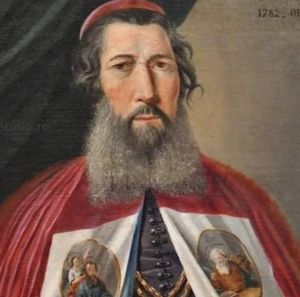
Bishop Ioan Bob
The census taken by the local authorities in 1786 showed that there were officially 310 Greek Catholic Romanians living in Cluj (about 100 families). In 1790 the Transylvanian government led by Gheorghe Banffy de Losoncz was re-established in Cluj, which created the opportunity for the Greek-Catholic Bishop of Blaj, Ioan Bob de Copalnic-Mănăștur, a member of the Diet, to visit Cluj. On this occasion, the Greek Catholics of Cluj asked the bishop to intervene with the authorities to approve the construction of a place of worship in the city, because they had to go to the Greek Catholic church in Cluj-Mănăștur.
At that time there was a decision of the local authorities in Cluj that conditioned the building of churches to congregations that already had churches built or to those that could prove that they had more than 100 families residing in the city. The Greek-Catholic Romanians in Cluj met these conditions, as they had more than 100 resident families in Cluj. Bishop Ioan Bob, who enjoyed great prestige in the eyes of the authorities, supported by the government secretary who also held the post of director of the Government Expediency, Mihail Oros de Fehéregyháza (a Romanian Greek-Catholic nobleman), succeeded in obtaining approval for the construction of a church within the city walls.
Building the church

The plan behind which Bob’s Church was built
It was signed between Bishop John Bob and Rozalia Gáborfi, wife of the regional commissioner Ladislau Tőkés, for the sum of 4,825 guilders. Two weeks later, on 24 May 1798, the bishop signed the contract for the design and building of the church with the architect Joseph Leder for 4,828 florins and two barrels of wine. The conditions of the contract were that the church should be built according to the plan drawn up by Joseph Leder (Baroque style) and approved by the authorities. The construction was also to be completed in two years and the dimensions of the church were to be as follows: length 9 cubits, width 5 cubits, height of the walls 4 cubits and height of the tower above the walls 4 cubits. The costs for the house, the garden and the church building were entirely borne by Bishop Bob, and the bishop’s trusted man in charge of supervising the works was the government secretary Mihail Oros who proved providential in the building of the church and the parish of Cluj.
On August 16, 1798, during a ceremony celebrated by Avram Meheși, the Protopope of Mănăștur, the foundation stone was laid for the beginning of the works. By the end of 1798 the walls were erected and some changes were made to the original plan (the tower was to be built in front of the church instead of above the choir as in the original plan). This was because the neighbour Ladislau Tőkés sold 3 boulders from his garden for the extension of the church and 6 boulders for its enlargement. In 1799 the church was almost finished, only the windows, the doors and the tower boards were missing because the brass was very hard to find due to the war.
Opening of the first Greek-Catholic parish in Cluj
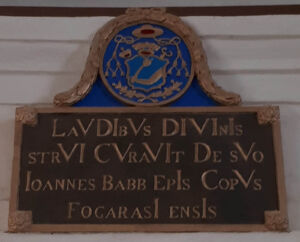
Sanctification plate
In the same year, a sacristy was built attached to the church (cost 349 florins and 22 crores) and work began on the tower, which was completed in the spring of 1801. Work also began on finishing the church, building the iconostasis and the pulpit, painting the main vault and the icons on the iconostasis, renovating the house next to the church, and landscaping the courtyard. All this work was completed in the summer of 1803. The total amount paid by Bishop John Bob for the construction of the church and the parish house in Cluj exceeded 13,000 florins. The consecration of the church dedicated to the Resurrection of the Lord was celebrated by Bishop Ioan Bob in the summer of 1803.
In the autumn of 1803 the parish of Cluj was elevated to the rank of protopope, and the first protopope was appointed parish priest of the church, Dimitrie Vaida de Glod, who in 1807 received the dignity of canon of the Cathedral Chapter of Blaj. The appointment as parish priest and protopope of Cluj of the priest professor Ioan Pop de Lemeni brought great changes in the educational and pastoral plan, obtaining from the bishop a paid post of chaplain. The parish of Cluj was also given the status of a moralis school, where newly ordained priests, as well as high school graduates who wanted to become priests, were trained in theological sciences (morals, liturgy and the use of the sacraments). The first apprentice and also the first chaplain of the parish was Ioan Duca, nephew of Bishop Ioan Bob.
The month of August 1817 was marked by a special event thanks to the visit of Emperor Francis I of Austria, who was a guest of Cluj from 18 to 27 August. On this occasion, on 24 August, the Emperor paid an unannounced visit to the Greek-Catholic church of Cluj, where he spoke with the Protopope Ioan Pop de Lemeni, taking an interest in the fate of the Romanians in Cluj.
Opening of the first romanian school in Cluj
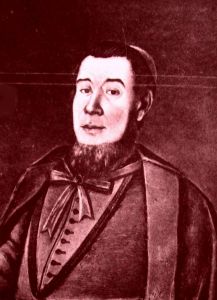
Bishop Ioan Lemeni
The events after 1848 created the opportunity to open a Romanian religious school, and Protopope Ioan Fechete Negruțiu took advantage of this. In 1853 he opened the first Romanian school in Cluj. The first teacher of this school is said to have been Grigorie Chis, but since no evidence of his existence has been found, we believe, based on certain documents, that the first teacher was the priest Grigorie Chifa, chaplain of the church and catechist of the Romanian children at the secondary schools in Cluj. In 1859 he was replaced at the confessional school by the teacher Iacob Murășan.

The first Romanian school in Cluj
On August 7, 1864 in this church took place the religious wedding between the university professor Ștefan Micle, future rector of the University of Iași and Veronica Câmpeanu (Micle), officiated by the protopope Ioan Pamfilie.
Bob church in Cluj had not only a spiritual and educational role, but also a cultural, social and national one. In 1861, Dean Ioan Fechete Negruțiu, a teacher of Romanian language and literature for Romanian students in Cluj’s high schools, founded a reading society for the city’s young Romanians, establishing its headquarters in the parish house. This tradition was continued by his successor, Protopope Ioan Pamfilie, who in 1866 founded another society for young Romanians, of which he was president until he left Cluj (1869), when he became a metropolitan canon.

Emperor Francis I of Austria
In 1872 the Franz Joseph University in Cluj was opened and the vice rector of the Central Seminary, St. Barbara” in Vienna, Grigore Silași, was appointed professor of Romanian language and literature for Romanian students. Here he founded, together with the Romanian students and the Greek-Catholic parish of Cluj, a reading society called “IULIA”, following the model of those in Vienna, with the aim of promoting the cultural and national development of the Romanian people. The priest professor Grigore Silași in collaboration with the protopope Gavrilă Pop founded in 1875 together with the leaders and the Romanian industrialists of Cluj, the Organization of Romanian Industrialists in Cluj Napoca. Moreover, in 1886 they founded the first Romanian credit bank in Cluj called “ECONOMUL”.

Parish House
During the first century of the church’s existence there was no need for major interventions (as far as we know), until the end of the 19th century when cracks began to appear in the walls and vaults. Most specialists of the time suggested that it was necessary to replace the brick vault with a lighter one on a rabitz structure. Their proposals were not followed, and in 1898 the walls were bound with iron bars and the cracks plastered over. This improvisation lasted until 19 August 1906 when, during Mass, part of the main vault collapsed. On this occasion, which could have been catastrophic, the first major intervention to strengthen the church was carried out. The main brick vault is dismantled and rebuilt on a rabitz structure. This work was carried out in the autumn of 1906 by the engineer Reizinger József for the sum of 4,402 crowns and 38 fils.
Building the first mixed school
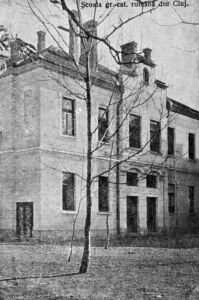
The confessional school built in 1907
The design and execution of the works were carried out by the engineer Pákey Lajos for the sum of 44,063 crowns and 85 ivory. Another great achievement of that year was the purchase of the garden in front of the school from Baroness Bornemisza for the huge sum of 20,000 crowns, of which 10,000 were donated by the great benefactor of the church Stefan Havași.
A moment that saddened the Greek Catholic community was when the martial law of the bells’ was imposed on the Bob Church in Cluj. On September 2, 1917, the copper plate on the church tower and the large bells were removed by the army to be turned into cannons and cartridges. They left only the smaller bell (about 50 kilograms) and put galvanized sheet metal on the tower.

The interior of the church after the 1922 renovation
In the summer of 1922, during the pastorate of the Protopope Dr. Elie Dăianu, under the care and at the expense of the Women’s Meeting ,,Sf. Maria”, partly sponsored also by the Commission of Historical Monuments of Transylvania, the church was restored and painted. On this occasion, electricity was introduced, a chandelier was installed (donated by the magistrate Gheorghe Sion), the main vault was painted blue and decorated with stars, the arches and pillars were decorated with crosses and the rest of the church was painted white. The Women’s Meeting of St. Mary was founded in this church by the priest Ștefan Roșianu on 16 June 1902.

The church after the bombing of October 9, 1944
The Second World War left its mark not only on people’s souls but also on the Bob Church in Cluj. On 9 October 1944 a shell fell on the neighbouring house and its courtyard, damaging the church roof and tower. The windows were also broken and the plaster fell from many parts of the church as a result of the shock to the walls. Because of this situation it was no longer possible to serve in the church, which is why, on 3 December 1944, the parish priest Dr. Vasile Astileanu opened a chapel in the premises of the parish house.

Bishop Florentin Crihălmeanu sanctifies the cross on the church tower
Restoration work began the following year and was completed in the spring of 1947. They began with the repair of the roof and the tower. They also closed the doors to the courtyard and to Bob Street, built two rooms at the sides of the tower, closed the door to the sacristy that connected to the presbytery and connected it to the altar via a tunnel. After all this, the interior and exterior plastering of the church continued. On 6 September 1945 the cross on the tower was replaced by a new one, cast in bronze. The following year, Professor Virgil Constantinescu painted the mural of the entire church, the old furniture was changed and a second bell donated by the Cluj City Hall was installed. The total cost of the work was 200,000,000 lei. The church’s rededication was officiated by Bishop Iuliu Hossu on 25 May 1947.
If we take stock of the first 150 years of existence of the Bob Church in Cluj, we will see many achievements, and of the priests who have pastored the parish, two became bishops, 14 became canons in the Cathedral Chapter and 22 were professors at the Theology in Blaj.
The disestablishment of the Greek-Catholic church
Return of the Bob Church in Cluj to its rightful owner

Altar
Immediately after the church was handed over, some maintenance work was carried out on the roof, the exterior plastering was completed, the paintings and icons on the iconostasis were cleaned, the sacristy was renovated and furniture was made. For two and a half years (2 July 1995-13 March 1998) the Bob Church functioned as the Cathedral of the Greek-Catholic Diocese of Cluj-Gherla.
Time has spoken and two centuries after the building of the church the cracks in the walls and vaults were more and more evident. The damp in the walls also affected the brickwork and plaster, and the roof, due to large cracks in the walls, shifted, allowing water to penetrate the vaults.

Bob Church
In 2016 the decision was taken to restore the church in general in order to increase the average number of visitors and with the help of the project management company Regional Consulting & Management SA, design Trimpex Gloria SRL, respectively technical assistance Ostentum SRL, the project “Rehabilitation and introduction into the tourist circuit of the Church “Resurrection of the Lord” – Bob” was implemented, obtaining European funds through the Regional Operational Programme 2014 – 2020, Priority Axis 5 – Improvement of the urban environment and conservation, protection and sustainable enhancement of cultural heritage, Investment Priority 5. 1 –

Conservation, protection, promotion and development of natural and cultural heritage. On 25 August 2017, the financing contract no. 358 was signed with the Ministry of Regional Development, Public Administration and European Funds (current name: Ministry of Development, Public Works and Administration) as Managing Authority and the North-West Regional Development Agency as Intermediate Body, and on 20 November 2018, following the competitive procurement procedure, the rehabilitation works contract was signed with the construction company Addconcept SRL. The works started on 6 May 2019, and on 5 November 2019, Bishop Florentin Crihălmeanu officiated the blessing of the cross on the church tower. The deadline for completion of the project is 24 August 2021. The total value of the project is 2,626,830.21 lei, of which 2,291,331.61 lei is non-reimbursable funding.
Currently Bob Church, to which Cluj II parish is affiliated, is administered by priest Nicolae Țap with priest Titus Simion Sas as vicar. Although the parish has a small number of parishioners (about 250), the church is also attended by parishioners from other parishes of Cluj. Since 1995, the “Angeli” choir, directed by teacher Angela David, has also been active in this church.